Views: 0 Author: Site Editor Publish Time: 2026-03-13 Origin: Site
Ever noticed how ceramic tiles or granite countertops shine like mirrors in finished spaces? Achieving that smooth surface is not accidental. It requires the right tools and careful polishing steps. One essential tool is the Diamond Polishing Pad, widely used in stone processing and surface finishing.
Ceramic tiles and natural stones such as granite, marble, quartz, and sandstone appear in floors, countertops, and architectural surfaces. They look durable and attractive, yet they still require precise finishing to reach their full visual quality. A diamond polishing pad helps remove scratches, refine textures, and gradually create a glossy surface.
In this article, we will explore several reliable Diamond Polishing Pad options used for ceramic tiles and natural stone. You will also learn how polishing pads work, what features matter most, and how professionals choose the right pad for different materials and polishing tasks.
A Diamond Polishing Pad uses industrial-grade synthetic diamonds as its main abrasive material. These diamonds are extremely hard and durable, making them ideal for polishing tough materials such as granite, marble, porcelain, and quartz.
Unlike conventional abrasives like aluminum oxide or silicon carbide, diamond particles maintain their cutting ability for a longer period. They remove scratches quickly and create a uniform surface finish. This efficiency reduces polishing time and ensures consistent results across different stone surfaces.
Because diamonds remain sharp under pressure, they allow operators to polish dense stone materials without excessive tool wear. As a result, diamond polishing pads are widely used in professional stone fabrication and construction finishing work.
Polishing stone surfaces requires a gradual process rather than a single step. Diamond polishing pads are manufactured in multiple grit levels, each designed for a specific stage of polishing.
Typical polishing stages include:
Polishing Stage | Grit Range | Purpose |
Surface Grinding | 30–100 | Removes deep scratches and uneven areas |
Honing | 200–400 | Smooths the surface and reduces scratch marks |
Polishing | 800–1500 | Develops surface clarity and shine |
Final Finish | 3000+ | Produces a reflective mirror-like finish |
Each stage removes the marks left by the previous grit. Skipping stages may leave visible scratches or uneven gloss.
Most diamond polishing pads are designed for use with angle grinders, handheld polishers, and automated stone polishing machines. Their flexible backing allows them to attach easily to polishing tools through hook-and-loop systems.
Pad diameter also affects performance. Common sizes include:
● 4 inch and 5 inch pads – Ideal for edge polishing and detail work
● 7 inch pads – Suitable for large flat surfaces
Selecting the right size improves control and ensures stable polishing performance.
Note: Always match the pad size with the polishing machine speed and torque to avoid uneven polishing results.
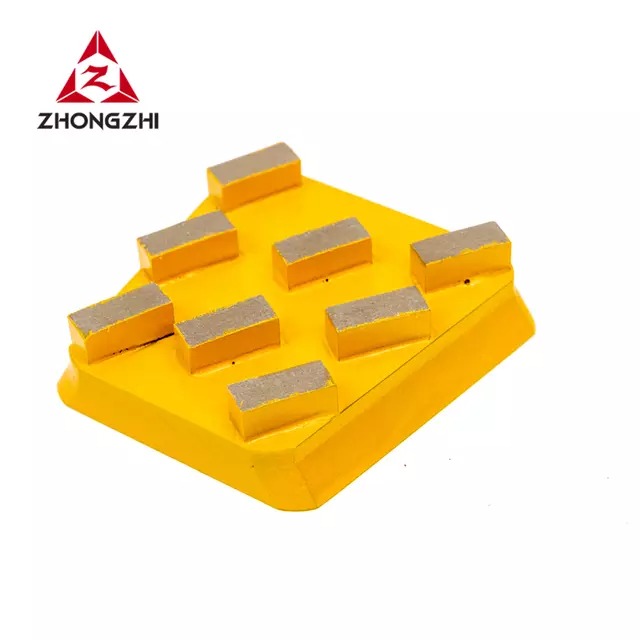
The ZHONGZHI Stone Grinding Diamond Frankfurt is designed for strong grinding performance during stone surface preparation. Its sandwich whole-sintered structure improves debris removal while maintaining effective cooling during grinding.
This structure allows the tool to maintain high sharpness while preventing overheating. It grinds efficiently without damaging the stone surface. Even delicate slate materials can be processed smoothly without scratches or breakage.
The tool performs well in early-stage grinding for ceramic tiles, marble, granite, sandstone, and other natural stones. It prepares the surface for later polishing stages, ensuring better final gloss results.
Key characteristics
● High grinding efficiency
● Stable cutting performance
● Improved cooling during operation
● Suitable for various natural stone materials
Specification
Specification (mm) | Grit Options | Segment Dimension | Segment Number | Note |
95 × 82 × 107 | 40#, 60#, 80#, 100#, 120#, 140# | 24 × 10 × 10 | 8 | Custom specifications available |
ZHONGZHI has manufactured diamond tools since 1989 and supplies products including polishing pads, grinding wheels, and cutting blades used in stone processing and construction industries worldwide.
The Slayer Diamond Elite polishing pad is designed for both wet and dry polishing conditions. This flexibility makes it suitable for fabrication shops as well as field installation work.
It offers a wide grit range from 50 to 3000, allowing operators to perform grinding, honing, and final polishing using one complete pad set. The pad performs well on granite, marble, porcelain edges, and engineered stone.
Because of its balanced design, it delivers consistent polishing results while maintaining good durability.
The Weha Trilogy system simplifies the polishing workflow. Instead of using many different grit pads, it completes polishing with only three steps.
This design helps reduce polishing time and tool changes during stone finishing work. The pad performs particularly well on quartz surfaces and dark granite materials where high gloss is required.
Many stone fabricators prefer this system when productivity is a priority.
Diamante Italia polishing pads are designed specifically for dry polishing environments. Their resin bond structure allows effective polishing without requiring water.
Dry polishing is useful during installation or repair work where water supply may be limited. These pads are available in several sizes and are compatible with common polishing machines.
They are frequently used for polishing marble and granite surfaces during on-site finishing.
Alpha Ceramica pads are widely recognized for consistent polishing performance on natural stones. Their design focuses on maintaining stable cutting ability across different polishing stages.
They perform well on materials such as marble, granite, and decorative stone surfaces. Fabricators often use them for finishing work where smooth gloss and surface clarity are required.
Tip: When polishing darker stones, consistent polishing pressure and slower machine speed often produce better surface clarity.
Some polishing pads are designed for wet polishing, while others work better in dry environments.
Wet polishing provides several advantages:
● Reduces heat buildup
● Removes polishing debris
● Produces smoother finishes
Dry polishing pads are convenient for on-site work because they do not require water supply. However, they may generate more dust during operation.
Pad thickness affects both durability and flexibility.
Pad Thickness | Characteristics | Best Use |
Thin Pads (2–3 mm) | Flexible and easy to control | Edge polishing and curved surfaces |
Thick Pads (6–8 mm) | Durable and stable | Large flat surfaces |
Flexible pads adapt better to curved edges, while thicker pads provide longer service life for large polishing jobs.
The quality of the diamond abrasive strongly influences polishing performance. High-quality diamonds maintain their cutting ability longer and produce smoother finishes.
Bond material also matters. Resin bonds provide flexible polishing and smooth finishing, while metal bonds offer stronger grinding capability during surface preparation.
Ceramic tiles are relatively hard but often have glazed surfaces. Medium to fine grit polishing pads work best for refining edges and removing minor scratches.
Operators usually avoid aggressive grinding to protect the tile surface.
Granite and quartz are dense materials. They require stronger grinding ability during early polishing stages.
Lower grit pads prepare the surface, followed by higher grit polishing pads that develop gloss and clarity.
Marble and travertine are softer stones compared with granite. They respond well to gradual grit progression.
Using a smoother polishing sequence helps create reflective surfaces while maintaining the natural texture of the stone.
Professional fabricators often rely on experienced manufacturers such as ZHONGZHI, which provides a variety of diamond tools for cutting, grinding, and polishing natural stone surfaces.
These tools support processing for materials such as granite, marble, sandstone, and ceramic products.
Stone polishing works best when the surface is refined step by step. Each polishing stage removes scratches left by the previous grit. When operators follow a proper grit sequence, the stone becomes smoother and the gloss gradually improves.
The table below outlines a typical grit progression used when polishing ceramic tiles and natural stone surfaces.
Polishing Stage | Typical Grit Range | Main Purpose | Result on Surface |
Surface Preparation & Grinding | 30–100 | Removes deep scratches, saw marks, and uneven areas | Creates a flat and prepared surface for later polishing |
Honing & Surface Refinement | 200–400 | Eliminates scratches left from coarse grinding | Produces a smoother and more uniform stone texture |
Fine Polishing & Gloss Development | 800–1500 | Refines the stone surface and increases clarity | Surface begins to show visible shine |
Final Buffing & Mirror Finish | 3000+ or Buff Pad | Provides ultra-fine polishing | Creates a reflective mirror-like finish |
Note: Clean the stone surface between polishing stages. Loose debris may scratch the surface during the next polishing step.
Wet polishing helps reduce friction and heat buildup during operation. It also carries away polishing debris, which improves surface quality and polishing consistency. Because water cools both the polishing pad and the stone surface, it can extend tool life and reduce overheating during longer polishing sessions. This method is commonly used in fabrication workshops where a reliable water supply is available.
Dry polishing is convenient for installation and repair work. It allows technicians to polish stone surfaces directly on-site without relying on water supply or additional equipment. This approach works well for quick adjustments during installation or edge finishing tasks. However, operators should use dust control equipment when polishing dry to maintain a clean and safe working environment.
The best polishing method depends on working conditions, material type, and polishing equipment. Fabricators often use wet polishing in workshops because it provides stable cooling and smoother finishing results. Dry polishing is more practical for on-site finishing tasks where water access may be limited or unavailable.
Achieving a refined finish on ceramic tiles and natural stone requires proper tools and careful polishing techniques. A reliable Diamond Polishing Pad helps remove scratches, smooth rough surfaces, and gradually create a bright, professional finish. When the correct pad structure and grit sequence are used, polishing becomes more efficient and surface quality becomes more consistent.
Understanding diamond abrasive quality, polishing stages, and working conditions allows fabricators to improve workflow and reduce surface defects. Specialized tools such as the ZHONGZHI Stone Grinding Diamond Frankfurt support stable grinding preparation and reliable polishing performance across materials like granite, marble, and ceramic tiles.
Manufacturers such as QuanZhou ZhongZhi New Material Technology Co., Ltd. provide advanced diamond tools designed for durability, efficiency, and consistent results. Their polishing solutions help professionals produce smooth, glossy stone surfaces that meet modern architectural and decorative standards.
A: A Diamond Polishing Pad is used to smooth and polish hard surfaces such as ceramic tiles, granite, marble, and quartz. It removes scratches, refines the texture of the stone, and gradually creates a glossy surface finish. Fabricators and installers use it during stone finishing or repair work.
A: A Diamond Polishing Pad contains industrial diamond abrasives that grind and refine the stone surface in stages. Each grit level removes marks from the previous step, allowing the surface to become smoother and shinier. This process helps achieve consistent, professional polishing results.
A: Yes, a Diamond Polishing Pad works well on both ceramic tiles and natural stones such as granite, marble, and quartz. Because diamond abrasives are extremely hard, they can polish dense surfaces while maintaining stable cutting performance.
A: Professionals choose a Diamond Polishing Pad because it cuts faster and lasts longer than traditional abrasives. Diamond particles maintain their sharpness during grinding, allowing smoother polishing and better control over the finishing process.
A: Choosing the right Diamond Polishing Pad grit depends on the polishing stage. Lower grits remove scratches and prepare the surface, while medium grits refine the texture. Higher grits create shine and final gloss on the stone surface.