Views: 0 Author: Site Editor Publish Time: 2026-06-17 Origin: Site
Achieving higher recovery rates and reducing operational waste are key objectives for modern quarry operations. While conventional extraction methods remain widely used, they often generate unnecessary stone loss, increase secondary processing requirements, and create structural imperfections that affect the final product quality.
Diamond wire saws have become an increasingly important solution for quarry operators seeking greater precision and efficiency. Their ability to produce smooth, controlled cuts helps preserve valuable material, improve block quality, and reduce overall extraction costs. In addition, the technology offers greater flexibility when working with complex geological formations and high-value stone deposits.
This guide provides a practical overview of diamond wire saw applications in quarrying, including equipment selection considerations, performance benefits, geological suitability, and methods for evaluating return on investment. By understanding these factors, quarry managers and decision-makers can make more informed equipment purchasing and production planning decisions.
Yield Optimization: Diamond wire cutting maximizes block integrity, increasing the volume of saleable dimension stone by eliminating micro-fractures associated with impact methods.
Operational Continuity: Proper implementation allows for continuous cutting of large-scale benches, significantly reducing the cost-per-square-meter of extracted stone.
Investment Value: While upfront consumable costs are higher, the reduction in labor, secondary squaring, and material waste drives a rapid return on investment.
Risk Mitigation: Success depends heavily on matching bead specifications to stone geology and maintaining rigorous tension and cooling protocols.
Explosives and repetitive mechanical wedging introduce massive inefficiencies into stone extraction. These brute-force methods create violent shockwaves. The resulting impact stresses the surrounding geological formation. It causes deep micro-cracking inside otherwise pristine stone. You lose significant volumes of high-grade raw material immediately.
Traditional methods rarely produce perfectly squared blocks. The irregular shapes demand extensive secondary processing. Operators must transport these jagged blocks to a fabrication facility. There, machines spend hours squaring the sides before any actual slab processing begins. This workflow consumes massive amounts of energy and labor.
Consider the downstream financial impacts of irregular extraction:
Increased Logistics Costs: You pay to transport excess waste rock to the processing plant.
Higher Energy Consumption: Secondary squaring requires large bridge saws running for extended periods.
Reduced Slab Yield: Irregularly shaped blocks yield fewer usable square meters of finished stone.
Slower Processing Times: Fabrication facilities face bottlenecks while preparing raw blocks.
Furthermore, regulatory agencies continuously tighten quarrying constraints. Dust emissions, ground vibration, and noise pollution from blasting attract strict penalties. These environmental pressures often force quarries to limit their operational hours. They complicate new permitting processes. You face shrinking profit margins as compliance costs rise.
Wire saws introduce a highly refined geometric precision to the quarry face. Operators execute clean, perfectly squared bench extractions. You cut the stone exactly where needed. This precision bypasses the costly secondary block dressing phase entirely. Plumb and flush blocks move directly from the quarry to the gang saw.
Large circular saws struggle with inherent depth limitations. Their blade diameters dictate maximum cut penetration. You must constantly reposition equipment for deep benches. In contrast, a wire loop offers virtually unrestricted cutting depth. Operators can thread long assemblies through deep boreholes. They slice massive sections of rock in a single continuous motion.
Directional flexibility sets this technology apart. You can adapt seamlessly to complex geological fault lines. Operators do not need to reposition heavy machinery constantly. They simply adjust the pulley arrangements.
Horizontal Cutting: Under-cutting the bench separates it from the bedrock cleanly.
Vertical Cutting: Slicing down the sides dictates the exact width of the block.
Blind Cutting: Specialized plunge pulleys allow cuts where intersecting boreholes are impossible.
Tip: When calculating efficiency gains, measure the reduction in secondary squaring time at the fabrication facility—precision at the quarry face directly lowers downstream processing costs.
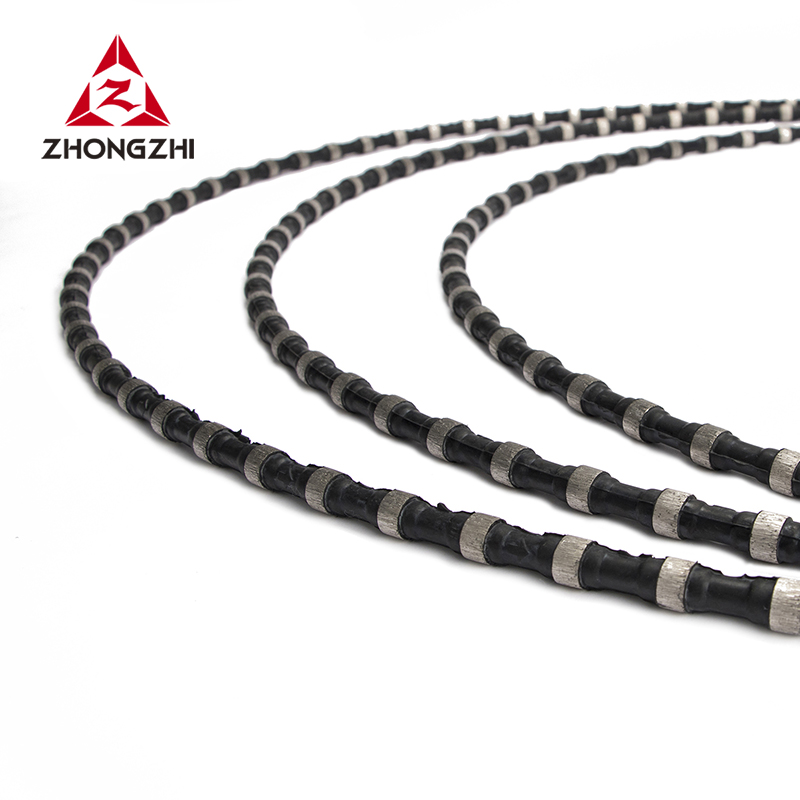
Selecting the correct consumables dictates your extraction success. You must match bead technology directly to the local geology. Sintered beads trap diamond particles inside a solid metal matrix. As the metal wears down, it exposes fresh diamonds. This process makes sintered beads perfect for highly abrasive, hard stones like granite. They prioritize longevity and durability.
Conversely, electroplated or vacuum-brazed beads bond a single layer of diamonds to the surface. These beads cut extremely fast. They excel in softer stones like marble or limestone. Using them in granite, however, strips the diamonds away rapidly.
Wire assembly and spacing also play critical roles. Standard assemblies usually feature 37 or 40 beads per meter. A higher density of beads increases cutting aggression. However, fewer beads per meter allow better chip clearance in dense stone. Proper spacing prevents the wire from jamming deep inside the cut.
We must also evaluate the injection coating. This coating protects the steel cable from abrasive slurry.
Bead Coating Material Comparison
Coating Type | Flexibility | Abrasion Resistance | Best Used For |
|---|---|---|---|
Rubber Injection | Very High | Moderate | Granite, Hard stone, High water penetration |
Plastic Injection | Moderate | Very High | Marble, Limestone, Cost-effective operations |
Machine compatibility ties the entire system together. You must pair your wire with a high-quality drive wheel. The machine must offer precise Variable Frequency Drive (VFD) tension control. VFD systems monitor the load on the main motor continuously. They adjust the tension instantly to prevent premature cable wear. A mismatched machine will stretch and snap even the best diamond cables.
Bringing this technology to the quarry floor requires strict operational discipline. Coolant system management stands as your first priority. You must deliver continuous, targeted water into the cut. Water flushes out thick stone slurry. More importantly, it prevents severe thermal degradation. Extreme heat causes the diamond matrix to graphitize. The diamonds turn to soft carbon and lose all cutting ability.
Tension and fatigue management prevent catastrophic equipment failures. Improper tensioning strains the internal steel core. Sharp bending radiuses near the exit hole cause intense localized friction. Operators face the highest risk of snapping the cable during the initial cut-in phase. The sharp edges of raw rock grab the beads aggressively.
Transitioning to this technology demands a shift in mindset. You move away from brute-force explosive extraction. You enter the realm of precision machine operation. Operators require dedicated training on VFD panel systems. They must learn acoustic monitoring. Experienced operators listen to the pitch of the cut. A high-pitched scream indicates poor lubrication. A deep grinding noise signals excessive tension.
Note: Insufficient water pressure deep within the cut is the leading cause of premature wire snapping and diamond bead glazing. Implement high-pressure, directional nozzles rather than passive flooding.
Evaluating the financial impact requires looking past initial price tags. You must break down the upfront investment versus the daily operational savings. Buying the machine and specialized wire consumables requires significant initial capital. However, you drastically reduce your hourly labor expenses. You also eliminate the recurring costs of explosive materials and detonators.
To measure true efficiency, adopt a strict cost-per-square-meter framework. This metric balances your consumable wear against your output volume. You track how many square meters you cut per linear meter of wire. You must also factor in electrical energy consumption or diesel fuel usage.
Cost Per Square Meter Calculation Framework
Cost Category | Measurement Metric | Impact on ROI |
|---|---|---|
Wire Lifespan | Square meters cut per linear meter | Directly lowers daily consumable expenses. |
Energy Draw | Kilowatt-hours per square meter | VFD control minimizes power spikes and waste. |
Labor Hours | Man-hours per extracted block | Automated cutting frees staff for other tasks. |
The yield premium represents your biggest financial upside. Extracted blocks show no internal fracturing. They maintain perfect orthogonal shapes. These defect-free blocks command premium prices in the global architectural stone market. Buyers pay more for blocks they can process immediately. The higher selling price per block accelerates your return on investment dramatically.
A diamond wire saw represents more than just an extraction tool. It serves as a strategic investment in overall yield optimization. It improves your downstream processing efficiency immensely. You extract perfectly intact stone blocks while reducing environmental impact. You lower secondary squaring times and minimize wasted raw material.
When selecting equipment, procurement teams should evaluate suppliers rigorously. Look for manufacturers who customize bead formulations to your specific quarry geology. Do not choose vendors strictly based on the lowest cost-per-meter. Cheap wire often snaps early or glazes over in hard rock.
Take proactive steps to modernize your quarrying operations today. Request a pilot test from a trusted tooling manufacturer. Ask for a thorough geological assessment of your rock face. Establish a clear baseline of your current cutting metrics before launching a full-scale rollout. Careful preparation guarantees a smooth and profitable technology transition.
A: Lifespan is highly variable based on the stone's quartz content and operator skill. It is typically measured in square meters cut per linear meter of wire. A high-quality assembly cutting medium-hard granite might yield 10 to 15 square meters per meter. Optimal VFD control and consistent water pressure extend this lifespan significantly.
A: Yes, operators can repair snaps on-site using specialized crimping tools and mechanical steel joints. However, you must manage repairs carefully. Excessive joints reduce the overall flexibility of the loop. This stiffness can lead to rough cutting and decreased operational efficiency over time.
A: Optimal linear wire speed, measured in meters per second (m/s), must match the stone hardness. Hard abrasive granite typically requires slower speeds between 22 and 26 m/s. Softer stones like marble allow faster speeds ranging from 30 to 38 m/s. Adjusting speed balances your cutting rate against premature bead wear.