What Is a Core Drill Bit and How Does It Work?
Views: 0 Author: Site Editor Publish Time: 2026-10-09 Origin: Site


A core drill bit is a hollow, tube-shaped tool. Its edge has diamond or carbide abrasive segments. This tool cuts by grinding or shearing a round groove into hard material. A solid cylinder of material, called a core sample, stays inside the barrel as you work. The global market for these tools in construction reached USD 1.14 billion in 2024, according to SkyQuest. That number shows how widely core drilling serves modern building projects. You use a core bit to make large, exact holes for pipes, cables, or vents. This post explains the working mechanism, types, selection, and maintenance of a core drill in simple terms.
Key Takeaways
A core drill bit is a hollow tube that cuts a ring-shaped groove and removes a solid core of material.
Diamond segments on the bit grind through hard materials like concrete and rebar; carbide teeth chip softer materials.
Choose a wet bit for water cooling and dust control; select a dry bit when water is not available.
Match the bit's bond hardness to your material: soft bond for hard stone, hard bond for soft abrasives.
Keep the bit cool with water, clean it after each job, and store it in a dry case to extend its life.
What a Core Drill Bit Is
Definition and Key Parts
A core drill bit is a round, hollow bit. You use it on hard stuff like concrete, stone, asphalt, tile, or brick. Unlike a normal twist bit that smashes everything, this tool has an open middle. The cutting only happens at the edge.
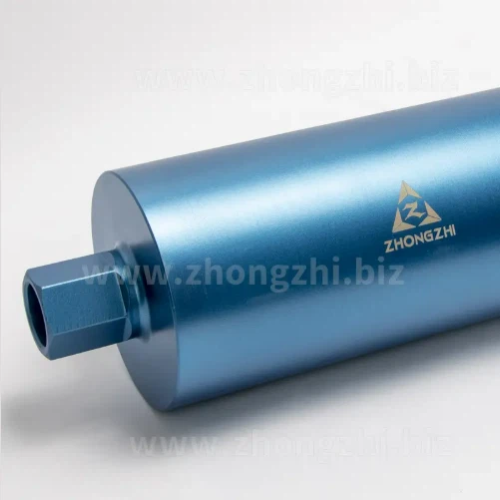
The barrel makes up the body. Companies like QuanZhou ZhongZhi, a diamond tool company that started in 1989, shape this barrel from strong steel. The barrel gives the core bit its shape, length, and strength. It must stand up to twisting forces and shaking during drilling. It also holds the cutting parts.
Diamond segments are on the cutting end of the barrel. These segments are not pure diamond. They are a mix of metal and fake diamond crystals. The segments set the cutting size and make the kerf, which is the groove's width. Methods like laser welding and sintering bond them and give strength and heat protection.
The arbor connection is the threaded or grooved end that fits the drill motor. Connection types are threaded, hex shank, or quick-change adapters. This part sends power from the motor to the cutting edge. A full coring tool often has three parts: a short coupling about 4 inches long, middle tubes in 12, 24, 36, or 48 inch lengths, and a crown with diamond segments. The 12 inch tube is the most common, and you can add more middle tubes to make a longer barrel.
How Core Drilling Removes a Core Sample
The ring-shaped cut sets this tool apart from normal drilling. A hollow barrel with diamond or carbide cutters spins fast. The bit cuts concrete in a circle, making a ring path. This action leaves a solid cylinder of uncut material inside the barrel. The material inside moves up into the inner barrel as you drill.
The bit can only go until it fills with core material. Then you must pull out the core before drilling more. A core lifter on the inner tube stops the sample from falling out when you lift the barrel from the hole. A tapered, split-ring lifter sits at the bottom of the inner tube. When you pull the drill string up, the lifter grabs the rock tightly. In hard, solid rock, rough inner ridges on a broach-style lifter dig into the material and break it off. In loose or broken rock, fluted basket-style lifters with flexible metal fingers close under the material's weight. This grip stops the sample from washing away.
You take out the core sample, and a round hole stays. The goal is useful: making big, exact holes for pipes, cables, or vents. In construction, concrete core drilling makes openings without harming the nearby structure. That exactness is why coring stays important on job sites.
How a Core Drill Works
Rotational Grinding and Shearing
When you use a core drill, the bit spins against the surface of the material. The cutting works by grinding, not by hitting. Diamond crystals on the edge slowly wear the rock away, grain by grain. This makes a narrow ring-shaped groove. Only the groove gets cut. The material inside the groove stays whole as a core sample inside the barrel. Surface speed depends on both bit diameter and RPM, so bits of different sizes have different edge speeds at the same RPM. You need to pick the right speed for your bit size.
The grinding method is different from impact drilling. Impact drilling uses fast blows to break the material, not steady grinding. Rotation clears debris and spreads wear during the process. A core drill uses steady rotation and weight-on-bit instead. Torque and weight grind the material without percussion. The metal bond holds each crystal in place. As the bond wears down, fresh crystals come out. This renewal keeps cutting efficiently.
Surface speed controls the cutting rate for every core drilling task. Choose your core bit RPM based on bit diameter. Pick the right speed for your diameter. A 1-3/8 inch bit runs at 600–900 RPM wet to get effective surface speed. Larger bits need lower RPM to avoid overheating. Too much speed causes glazing on the diamond surface. Glazing stops the cutting action completely. You must dress the bit on an abrasive block to bring it back. Automated control systems can adjust speed and feed rate in real time to improve cutting performance.
Feed force matters too. Apply steady, moderate pressure to keep the crystals biting. Too little causes glazing. Too much leads to overheating or exit chipping. Water carries away heat and flushes slurry. Wet drilling is the default method. Dry drilling needs lower speeds and intermittent pecking to manage heat.
Bond hardness affects grinding efficiency in a surprising way. The table below contrasts the two main drilling methods.
Drilling method | Operating principle | Main mechanism | Suitable rock or application |
|---|---|---|---|
Impact drilling | Uses high-frequency blows combined with rotation to fracture rock | Percussion delivers thousands of blows per minute; rotation clears debris and distributes wear | Hard rock and deeper holes |
Rotary drilling | Uses rotation and weight-on-bit, with minimal percussion | Torque and weight-on-bit shear or grind the material | Softer sedimentary layers and exploration; diamond core drills extract cores |
Soft bond bits work best on very hard materials like granite or cured stone. The hard material dulls the crystals quickly. The bond must erode fast to expose fresh ones. A bond that is too hard will not erode, causing your core drill bit to glaze over and stop cutting. Hard bond bits fit soft abrasive materials like asphalt. These materials act like sandpaper and try to strip the segments away. A hard, wear-resistant bond protects the segments and holds the crystals longer. Matching bond hardness to the material's abrasiveness profile maximizes your core bit lifespan.
Diamond vs. Carbide Cutting Edges
The choice between diamond and carbide cutting edges depends on your material. Diamond core drill bits use synthetic segments in a metal matrix. A core bit with diamond segments works through these core drilling tools. A diamond core bit handles reinforced concrete with rebar. The crystals cut through both concrete aggregate and steel reinforcement. They produce clean holes with fewer rejects and no rework.
Carbide core bits chip through soft material. Carbide teeth chip away at the material. These bits work well on softer materials like brick, cement blocks, wood, plastic, and aluminum. They cost less per unit and drill fast for general construction jobs. Hybrid bits handle both material types without tool changes.
However, carbide bits struggle with hard materials. They wear rapidly on steel rebar. TCT bits only handle light mesh. For heavy rebar, choose diamond bits. Diamond-tipped core drills require a rig and water supply, which raises setup overhead. But they offer lower total cost per hole in rebar-dense work due to fewer failures.
Bond hardness adds another layer to core bit performance. For hard materials like cured stone, choose a soft bond. For soft abrasive materials like green block, choose a hard bond. The right match extends your core bit life and maintains cutting speed.
Types of Core Drill Bits
Wet vs. Dry Bits
You face a basic choice when you pick a core drill bit: wet or dry. Wet diamond core drill bits use water or coolant to control heat and dust. This method suits heavy-duty work and hard materials like reinforced concrete and stone. Water binds dust into slurry and prevents airborne silica dust. The flow usually meets OSHA silica rules by default. Continuous water flow also keeps temperatures low. This extends bit life significantly and enables faster cutting.
Dry diamond core drill bits work where water is impractical. Advanced bonding technologies manage heat while still delivering clean results. However, dry drilling produces fine hazardous dust. You need vacuum shrouds with HEPA filters to meet OSHA silica rules. Without water cooling, your core bit is more prone to overheating, glazing, cracking, and rapid wear. For field work, dry bits rely on open segment design and short-burst drilling to dissipate heat. They wear faster and yield slightly less clean edges than wet bits.
Segmented vs. Continuous Rim
The rim design of your core bit determines which materials it can cut. Segmented core bits have gaps between diamond segments. These gaps let debris escape easily and suit harder stone like granite and quartz. You also use them on concrete, asphalt, and stone. Continuous rim bits have a solid edge with no gaps. They depend on steady flushing to stay clear. These diamond bits work best on delicate stone like marble, travertine, and quartz. They also handle tile and granite.
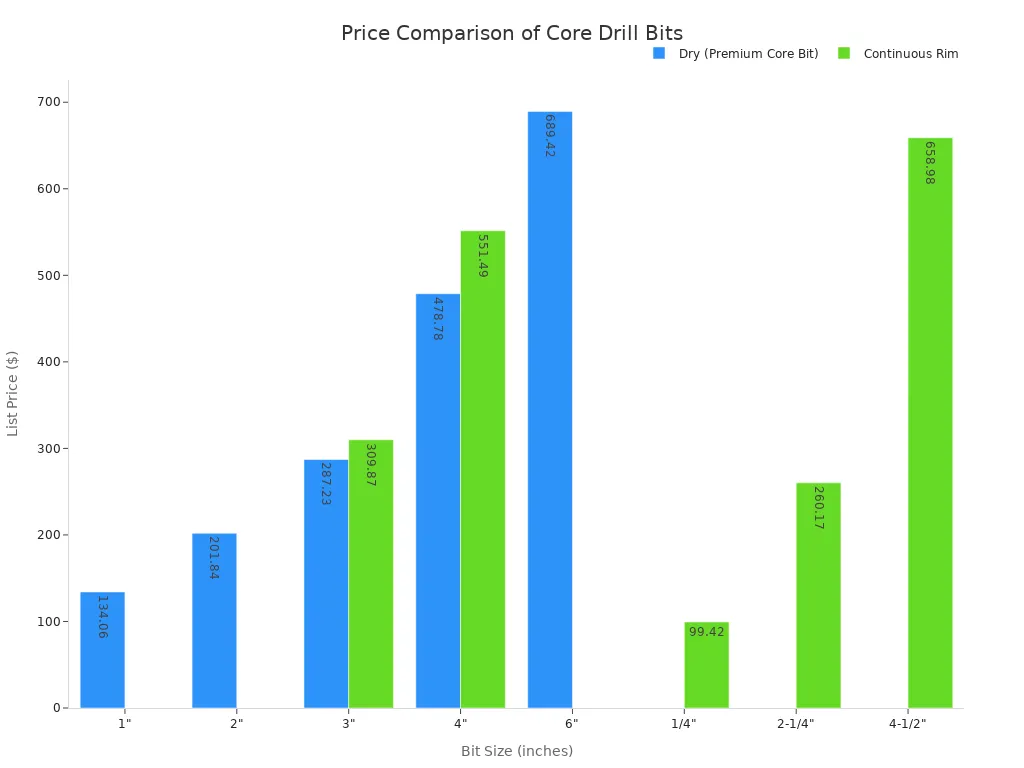
Price varies by type and size. A dry premium core bit costs $134.06 for 1 inch and $689.42 for 6 inches. A continuous rim bit runs $99.42 for 1/4 inch and $658.98 for 4-1/2 inches. These core drilling tools serve different needs. A hole saw or annular cutters may fit smaller jobs. But for large, precise holes in concrete, a dedicated core drill remains the standard choice.
Choosing the Right Bit
Matching Bit to Material
Your material decides almost everything about bit selection. For concrete, stone, asphalt, tile, and masonry, pick a bit with industrial-grade diamonds or tungsten carbide segments embedded on the rim. These edges grind through extremely hard surfaces. The hollow barrel then removes a solid core instead of pulverizing the material. That is why core drilling delivers smooth, low-impact, precise cylindrical cuts.
Aggregate hardness and rebar density change the diamond system you need. Coarse grit cuts faster but leaves a rougher finish. Fine grit drills slower and produces smoother holes. Match the bond matrix to the material: a soft bond suits high-strength reinforced concrete because it exposes fresh diamonds quickly, while a hard bond resists the excessive wear that softer concrete or brickwork causes. For heavily reinforced concrete, a roof and net compound type segment offers sharp penetration and efficient slag removal. Diamond bits or specialized carbide-tipped bits designed for reinforced concrete also work well when rebar is dense.
Glass and porcelain demand a gentler approach. Use diamond bits, drill at slow speed, and apply gentle pressure. Water acts as a lubricant and coolant, which reduces heat and prevents cracking or chipping. Angle the drill when starting, then straighten once the initial hole forms. A small piece of masking tape at the starting point stops the bit from sliding, especially with larger sizes.
Checking Drill and Arbor Fit
A perfect bit still fails if it does not attach to your machine. Thread counts vary by region and size. The 5/8"-11 coarse thread serves the North American market for concrete, masonry, and hard materials. The 1 1/4"-7 thread fits larger bits and bigger diameter holes in thicker materials. Metric regions use M14, while M16 covers larger metric bits. Mismatched threads simply will not connect.
Start by identifying the connection your machine requires, such as M16, an SDS Plus adapter, or another system. An M16 core bit can attach to a rotary hammer through a suitable SDS Plus adapter. Remember that machine connection and operating mode are separate concerns. Using an SDS adapter does not mean you should run the bit in hammer mode. Always follow the manufacturer's recommended mode for diamond core drilling.
Benefits and Maintenance of Drilling
Accuracy, Speed, and Safety
Core drilling makes holes that are exact and clean. You get precise cuts without hurting the structure around them. This way works faster than breaking through material with a hammer and chisel.
Safety matters during any drilling job. OSHA has clear rules. Always wear personal protective equipment. Safety goggles protect your eyes. Dust masks stop silicosis. Gloves protect your hands. Earplugs shield your hearing above 90 decibels. Boots and strong clothing finish your setup.
Cover drilled openings the right way. Use steel plates or plywood strong enough to hold workers. Mark open areas with tape. Fasten coverings tightly. Learn how to run your machines. Know hazards like electrical lines. Follow emergency shutdown steps.
Safety Category | Recommended Procedure | Details |
|---|---|---|
Protective Equipment | Eye protection | Safety goggles or face shields |
Dust masks | Required where heavy dust accumulates | |
Gloves | Durable gloves for sharp edges | |
Hearing protection | Earplugs or earmuffs above 90 dB | |
Protective clothing | Sturdy clothing, steel-toe boots | |
Hole Coverings | Proper coverings | Steel plates or reinforced plywood |
Mark hazard areas | High-visibility tape or warning signs | |
Secure coverings | Fasten firmly to prevent shifting | |
Training | Proper tool use | Operate and maintain machinery |
Hazard awareness | Electrical lines, structural weaknesses | |
Emergency procedures | Shutdown, first aid, contact services | |
Equipment Maintenance | Inspect before use | Check for cracks, worn wiring |
Proper barrel use | Match barrel to material | |
Secure fitting | Prevent wobbling or detachment | |
Lubrication and cooling | Maintain water or air cooling | |
Maintenance schedule | Routine cleaning and testing |
Cooling, Cleaning, and Storage
Cooling is very important when you drill. The cutting area makes a lot of heat. You must remove this heat the whole time.
Core drilling makes a lot of heat at the cutting area — both from the friction of diamonds rubbing stone and from the squeezing of the stone material. This heat must be removed nonstop or two things happen: the diamonds in the bit matrix glaze over and thermal shock can crack the stone. A steady flow of water through or around the bit keeps temperatures at the cutting face low, washes stone slurry out of the kerf, and greatly extends bit life.
After drilling, clean your core bit. Rinse it with clean water. Scrub it with a wire brush to remove debris. Dry the bit all the way before you store it.
Keep your core bit in a dry, clean place. Use a strong case or padded pouch. Stay away from direct sunlight and extreme temperatures. Protect the diamond segments from harm. Check the bit for cracks before each use.
Follow a regular care routine. Check the bit for chipped or missing diamond segments before you use it again. Make sure the bond between segments and barrel stays tight. Run the drill at the right speed. Use steady, moderate pressure. Sharpen the bit sometimes by running it briefly on a cinder block. Line the bit up straight with the surface. Keep the bit cool and lubricated during every job.
A core drill bit is a hollow abrasive tool. It cuts by grinding or shearing and pulls out a core sample. You get clean holes when you match the bit type, abrasive material, and size to your workpiece and drill. This matching also extends bit life.
Apply the selection and maintenance guidance from this post. Check your drill and arbor fit before you start. Keep the core bit cool and clean after every job. Store it in a dry case. These habits give you safe, efficient drilling with high-quality results every time.
FAQ
How do I know which core drill bit to choose?
First, match the bit to your material. Diamond bits cut reinforced concrete and stone. Carbide bits work on brick and block. Check your drill's arbor thread before you buy. QuanZhou ZhongZhi sells many diameters and connection types for different machines.
Can I use water with any core bit?
No. Wet drilling needs bits made for water cooling. Dry bits use a different bond that handles heat without coolant. Using water on a dry bit may harm the segment bond. Always follow the maker's guidance for your exact core bit.
How long does a core drill bit last?
Bit life depends on material hardness, drilling speed, and cooling. Diamond bits last longer in reinforced concrete than carbide options. Good water flow and moderate feed pressure make service life longer. You will see glazing or slow cutting when the bit needs to be replaced.
What should I do if I hit rebar while drilling?
Stop right away. Diamond core drilling handles rebar, but carbide bits wear fast on steel. Switch to a diamond bit for reinforced sections. Lower the feed pressure and keep water flowing. This approach protects your equipment and makes cleaner holes.