What Is A Diamond Segment?
Views: 0 Author: Site Editor Publish Time: 2026-05-25 Origin: Site


Industrial cutting processes demand absolute precision and reliable equipment. Choosing an incorrect Diamond Segment causes serious downstream issues. You risk premature tool failure and introduce severe safety hazards to your job site. Incorrect tooling also heavily inflates your cost-per-cut. Operators often deal with shattered blades or stalled projects. These problems arise when they ignore the underlying physics of their cutting tools. We must move beyond basic product definitions to solve this. This article provides a comprehensive technical evaluation framework. You will learn how to match segment metallurgy to your specific target materials. We will explore optimal geometry choices. We will also examine how machine power impacts your industrial cutting applications. Understanding these variables transforms your equipment from a basic consumable into a highly engineered asset. Let us dive into the mechanical realities of diamond tooling.
Key Takeaways
A diamond segment’s performance relies on a continuous consumption cycle where the metal bond wears away to expose fresh diamond crystals.
Selection follows an "inverse rule": Hard materials require soft bonds, while highly abrasive/soft materials demand hard bonds.
Machine horsepower is a critical, often-overlooked variable; underpowered saws cause segment glazing, while overpowered saws cause rapid degradation.
The Anatomy of a Diamond Segment: Crystals and Metal Matrix Bonds
A high-performance cutting tool requires complex engineering. You must understand its internal structure to prevent catastrophic failures during high-stress operations. Every tool consists of a working layer and a distinct transition layer.
Working Layer vs. Transition Layer
The active cutting zone is the working layer. It contains synthetic diamond crystals suspended firmly in durable metal alloys. Engineers carefully select ratios of copper, tin, cobalt, and tungsten carbide. Copper and tin create softer matrices for hard materials. Cobalt and tungsten carbide build incredibly durable matrices for highly abrasive environments. They create a matrix designed to hold the diamonds securely. Below this sits the diamond-free transition layer. This base layer exists for a highly specific structural reason. It allows secure laser welding directly to the steel core. If you tried welding the working layer directly, the intense heat would destroy the synthetic diamonds. This would compromise the entire tool structure and cause immediate failure.
The Micro-Fracture Cycle
Understanding the working principle is crucial for operators. A Diamond Segment does not actually "cut" in the traditional sense. It grinds material away through intense friction. The process relies on a continuous micro-fracture cycle. The metal bond matrix must wear down at a precise rate. It wears away right alongside the diamonds. This continuous action exposes sharp, new cutting edges. If the bond refuses to wear, the exposed diamonds become dull and rounded. The cutting process then stops entirely.
Variables of Concentration
Diamond grit size and concentration dictate your material removal rates. High concentration means more diamonds touch the material simultaneously. However, this lowers the individual pressure on each crystal. You use high concentration for hard materials to prolong tool life. Larger grit sizes remove large chunks of material very quickly. Smaller grits provide a cleaner, much smoother finish. You must tailor these metallurgical variables to your specific application. Understanding the exact metallurgical composition of the bond is the foundational step in preventing segment failure.
The "Inverse Rule" of Material Matching
Selecting the right bond hardness often confuses new operators. You must follow a counter-intuitive principle known as the "inverse rule." You match the bond hardness inversely to the material hardness.
Hard Materials (Cured Concrete, Granite)
Extremely hard materials require softer metal bonds. When you cut cured concrete or dense granite, the diamond crystals dull very quickly. A soft bond sheds away faster under this friction. This rapid shedding maintains overall tool sharpness. It quickly releases the dulled diamonds to expose fresh ones beneath them. If you use a hard bond here, the tool will simply glaze over.
Soft and Abrasive Materials (Asphalt, Green Concrete, Sandstone)
Conversely, soft and abrasive materials require exceptionally hard bonds. Green concrete and asphalt contain high amounts of loose sand. This silica acts like aggressive sandpaper against the metal matrix. The high presence of loose debris will erode the matrix prematurely. A highly wear-resistant bond prevents this rapid erosion. It holds onto the diamonds longer. This ensures they complete their useful life before falling out into the trench.
Material-Specific Formulations
Demanding materials like basalt or volcanic rock require advanced engineering. Manufacturers use multi-layer or sandwich designs for these applications. These formulations feature alternating layers of varying bond hardness. This specific design enhances cooling channels naturally. It also improves debris clearance during very deep cuts. You achieve smoother operation and significantly less heat buildup.
Best Practice: Always audit the silica content and abrasiveness of your target material. These abrasive factors dictate the required bond hardness far more than the structural density of the material itself.
Evaluating Segment Geometry and Manufacturing Methods
Physical shape dictates how a tool interacts with a surface. You must pair the correct geometry with the proper manufacturing method to achieve optimal results.
Geometry and Aggressiveness
The physical profile of a Diamond Segment directly impacts cutting speed and surface finish.
Turbo/Corrugated: This design features serrated edges. It offers fast material removal while leaving a moderate finish. The corrugated shape reduces surface friction significantly. It creates micro-channels for airflow. This passive cooling keeps the blade stable during intense use.
U-Groove/Slant Slot: You need this shape for asphalt and highly abrasive applications. The deep grooves act as escape routes. They prevent loose debris from clogging the cutting path. This significantly reduces heat buildup and prevents core warping.
Arrow/PCD: Polycrystalline Diamond (PCD) and arrow shapes offer extreme aggressiveness. They excel at coating and thick epoxy removal. However, they are highly susceptible to impact damage. You must keep them strictly away from embedded rebar.
Manufacturing and Welding Processes
The way a segment attaches to the core dictates its safe operating limits.
Laser Welded: This process uses focused lasers to melt the transition layer into the steel core. It is absolutely mandatory for heavy-duty, dry-cutting concrete applications. It prevents catastrophic segment detachment under extreme heat.
Silver Brazed: Manufacturers use a silver alloy to fuse the components together. It represents the traditional standard for wet-cutting stone. It offers highly controlled, clean cuts. You must never use silver-brazed tools in dry applications.
Vacuum Brazed/Sintered: These methods offer cost-effective or highly specialized options. Vacuum brazing exposes a single layer of diamonds for extreme initial sharpness. Sintering presses the mixture under high heat for general masonry tasks.
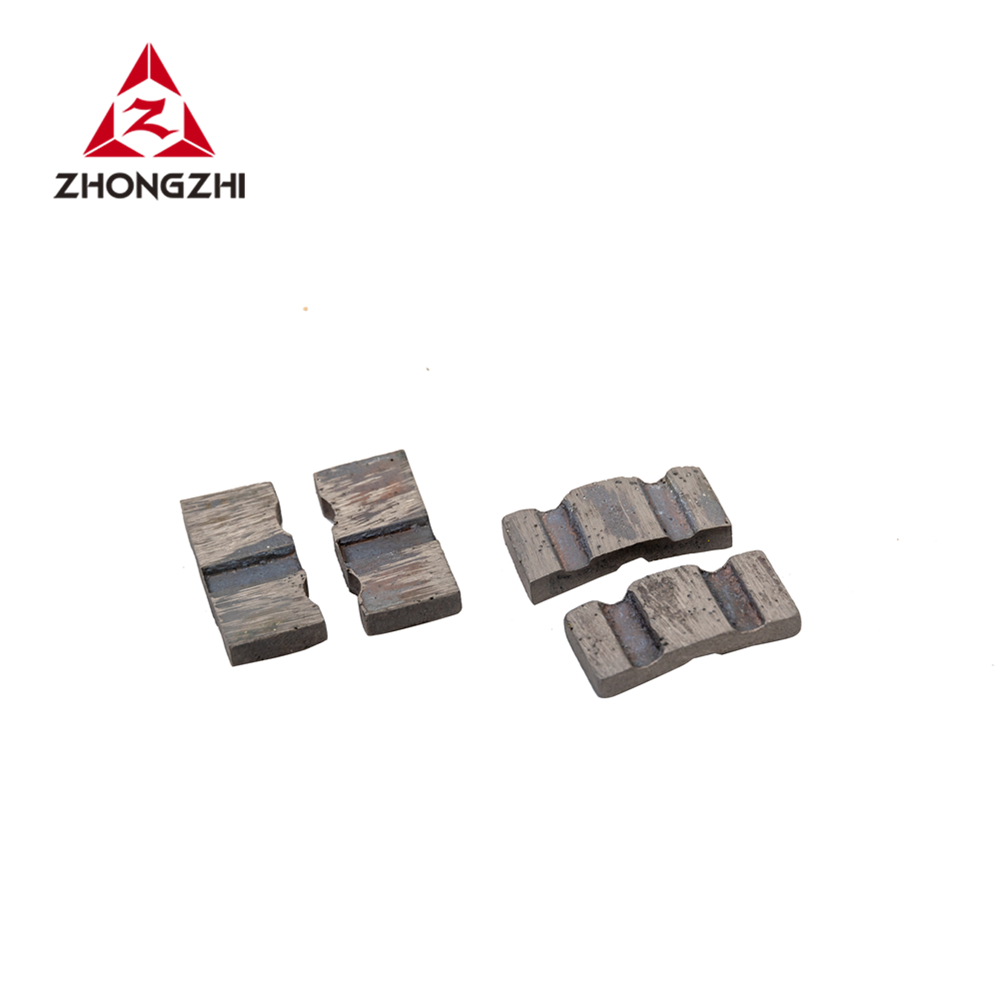
Premium diamond segments laser-welded onto a heavy-duty steel core for industrial cutting.
Critical Equipment Variables: Machine Power and Segment Height
Tool buyers often obsess over materials but ignore their own machinery. Machine capability stands as a primary failure point if mismatched with the tool.
The Horsepower Impact
Your machine's horsepower directly alters the micro-fracture cycle. You cannot interchange blades between drastically different saws expecting identical results.
Overpowered Machines: Running a standard blade on a high-horsepower saw generates excessive kinetic heat. The immense friction causes the metal bond to melt or wear far faster than anticipated. This rapid degradation destroys your project budget and ruins the tool entirely.
Underpowered Machines: A weak saw fails to provide the necessary downward force. It cannot generate adequate rotational speed. The bond does not wear down correctly. The diamonds simply dull against the surface. The tool glazes over and stops cutting. Operators often mistakenly blame the blade for this machine failure.
Optimizing Segment Height
Taller segments do not automatically guarantee better performance. You must optimize the height based closely on the application.
Higher profiles, typically ranging from 12mm to 15mm, work well for heavy concrete. They increase the total volume of available diamonds. This provides deeper cuts over an extended timeline. Lower profiles prevent blade deflection. You use shorter heights on delicate materials like porcelain or ceramics. A lower center of gravity minimizes lateral vibration. This prevents edge-chipping on fragile surfaces.
Common Mistake: Never procure diamond tooling without verifying your equipment specifications. Ensure the operating RPM and horsepower of your fleet fall strictly within the engineered tolerances of the segment.
Implementation Realities: Maintenance and Customization Requirements
Proper maintenance and exact specification ensure your tools perform at their peak. You must treat them as engineered systems requiring precise handling.
Troubleshooting "Glazed" Segments
Even perfectly matched tools can sometimes glaze over. Glazing occurs when the diamonds dull, but the bond fails to shed. You can easily fix a dull tool through a practical process called "dressing."
To dress the blade, simply make several cuts into a soft, highly abrasive material. You can use an old cinder block or a specialized dressing stone. The abrasive sand in the block strips back the hard metal bond. This action exposes a fresh, sharp layer of new diamonds. Your tool will immediately regain its original cutting speed.
Specifying Custom Segments (OEM/ODM)
Standard off-the-shelf options often fail in specialized industrial tasks. You must provide specific parameters when ordering custom tools. List these five non-negotiable engineering parameters for accurate customization:
Target material composition: Define the exact hardness and silica content.
Carrier tool/machine type: Specify the horsepower, RPM, and mounting style.
Desired operational outcome: State whether you prioritize cutting speed or smooth finish.
Required welding type: Choose laser welding for dry cuts or silver brazing for wet cuts.
Optimal geometric shape: Select turbo, U-groove, or flat profiles based on debris clearance needs.
Best Practice: Establish a strict on-site monitoring protocol. Teach operators to identify early signs of segment glazing or uneven wear. They must dress the tool immediately before the friction overheats and ruins the steel core.
Conclusion
Modern industrial cutting requires us to view tooling as engineered assets, not just commodity consumables. The correct choice dictates project safety, execution speed, and bottom-line profitability. You must move away from generic purchasing habits.
We recommend standardizing your procurement process immediately. Start by auditing your current machine horsepower. Analyze your primary cutting materials for hardness and abrasiveness. Finally, review your historical tool failure rates to identify mismatch patterns. Taking these steps eliminates costly guesswork.
Consult with a tooling engineer before your next major project. Formulate a custom metal bond matched directly to your exact operational requirements. Precision in selection guarantees precision in execution. Upgrade your evaluation framework today to secure safer, faster, and more profitable cutting operations.
FAQ
Q: Why do diamond segments lose their cutting ability despite having visible height left?
A: This happens due to "glazing." The metal bond is too hard for the material being cut. The exposed diamonds dull from friction, but the bond does not wear away to release them. Without fresh, sharp diamonds exposed, the tool simply rubs against the surface instead of grinding it.
Q: What is the purpose of the segment transition layer?
A: The transition layer is a specialized, diamond-free metal zone at the base of the segment. It exists solely to allow secure laser welding to the steel core. If diamonds were present in this welding zone, the intense heat would destroy them and severely weaken the joint.
Q: Does a higher diamond segment always mean a longer lifespan?
A: No. Lifespan depends more on matching the correct bond hardness to the material's abrasiveness. A very tall segment with an incorrect, soft bond will wear out rapidly on abrasive asphalt. The metallurgical formulation dictates longevity far more than sheer physical height.
Q: Can I use a wet-cutting diamond segment for dry applications?
A: Absolutely not. Wet-cutting tools typically utilize silver-brazed joints. This type of weld melts at lower temperatures. If used dry, the extreme friction heat will melt the silver brazing. This leads to catastrophic failure where segments detach and fly off at high speeds.